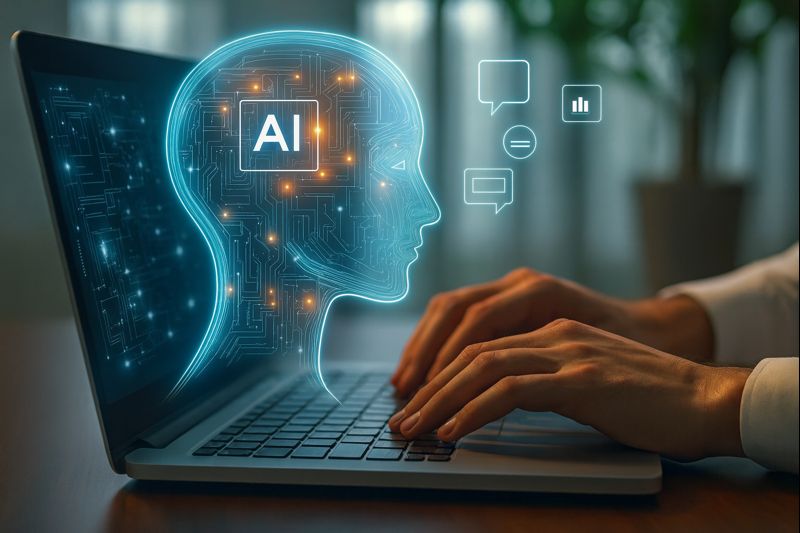
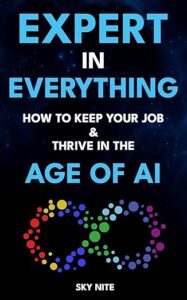
There is a lot of fear and uncertainty surrounding AI and jobs. A lot of this is fueled by big headlines from AI-company CEOs like “AI could wipe out half of entry-level white-collar jobs in the next 1-5 years.” However, if you talk to experienced software developers, familiar with AI tools and seeing the highest adoption of any industry, the overriding consensus is that we need just as many (or even more) people working, but that the scope of what is achievable has increased, with the desired skillsets evolving.
As amazing as modern AI is, it’s far from full automation. Most of the attention-grabbing headlines have to do with Artificial General Intelligence (AGI), which means AI that can perform as well as or better than a human in all tasks. While such invention would have dramatic effect on what can be automated, significant new breakthroughs are needed, which most experts place in the 10-20 year range (a range that tends to stay perennially that long, since it’s impossible to predict scientific breakthroughs with accuracy). Fusion energy has been 30 years away for over 70 years, after all. That said, current AI tech and its refining forms WILL have a massive impact, just not how most people think.
Every industry will see AI adoption in the coming years just like the adoption of computers and the internet (but swifter). The newness of AI makes it exciting and threatening, but in 5-10 years most of it will be boring and just a part of our work stack we take for granted. Software development may be the exemplar for widespread AI usage, but it is following a pattern that is proving the rule for other industries.
Why Hybrid Human-AI Workers Win
It essentially goes like this: you have three different team members. One has embraced AI usage to improve their work as a hybrid human-AI worker, the other doesn’t touch AI, and the third relies almost entirely on AI. The no-AI team member finishes work like before, but if they need to work outside of their dominant expertise or coordinate with such people, the progress is slow going (which traditionally makes sense). The AI-reliant team member produces lots of “stuff”, but the quality of that “stuff” is relatively low, and creates editing/checking burden on the rest of the team, or hurts the quality of what your company produces. The AI-hybrid teammate produces fantastic work at an average rate that is modestly faster than the no-AI teammate, but much faster for areas of less expertise.
If your company’s leadership tells you that you need to reduce headcount on your team by one as part of a widespread general layoff, you’re certainly going to keep the AI-hybrid team member. You might even lay off both other workers and hire a new person with existing AI-hybrid skills if you can’t convince the no-AI team member to adopt them, since with headcount reduced by one but the work burden the same, the team will need to be able to work more flexibly.
Real-World Examples of AI in Action
So, we’ve talked generally, but what are some concrete wayspeople are using AI to work more effectively?
in procurement, performing analysis on an upcoming negotiation plan, refining your objection handling and finding more ways to be prepared
in customer service, drafting suggested responses in call centers
in product management, ideating step-by-step plans to achieve business goals
in analytics/growth, analyzing customer behavior to identify high-value prospects for sales
in insurance, analyzing images for product damage
in L&D, providing personalized learning
These are just a handful of the many uses of AI in the workplace, but hopefully give you a picture of how widespread and varied the uses are. In the world of tomorrow (but actually happening right now), being unable to use AI effectively will be akin to being unable to use a computer effectively. During this transition of AI from new and exciting to boring and expected, those willing to learn early will have the edge.
Sky Nite is an Engineering Manager and seed-stage CTO with 10+ years of experience turning AI and XR ideas into revenue-generating products. He has led lean teams of 3–17 and managed $3M+ budgets to deliver platforms with 99.9% uptime and Fortune 500 adoption. Skilled across the full stack—Python, JavaScript, C#, Unity, deployment, and security compliance—Sky combines hands-on technical execution with board-level strategy. The author of three tech industry books with 10,000+ copies sold, he brings rare communication skills that help products launch fast, scale reliably, and delight customers.